
At a young age, Tony Hsu knew he wanted to become a nurse but didn’t anticipate how his highly specialized position would prepare him for three midair rescues.
At 12 years old, he was diagnosed with anti-HMGCR immune-mediated necrotizing myopathy, a rare autoimmune muscle disease in which the immune system attacks the muscles, causing muscle weakness and pain typically in the muscles closest to the trunk of the body.
For a year, severe muscle weakness limited Hsu’s mobility. After medication helped him regain his strength, he said, he felt inspired to become a nurse and help others.
Growing up in Chicago and later working as a registered nurse at Northwestern Memorial Hospital, he was committed to providing meticulous care and a good bedside manner, qualities that made him perfect for the role he stepped into a year and a half ago at UT Health San Antonio.
Collecting cells, building trust
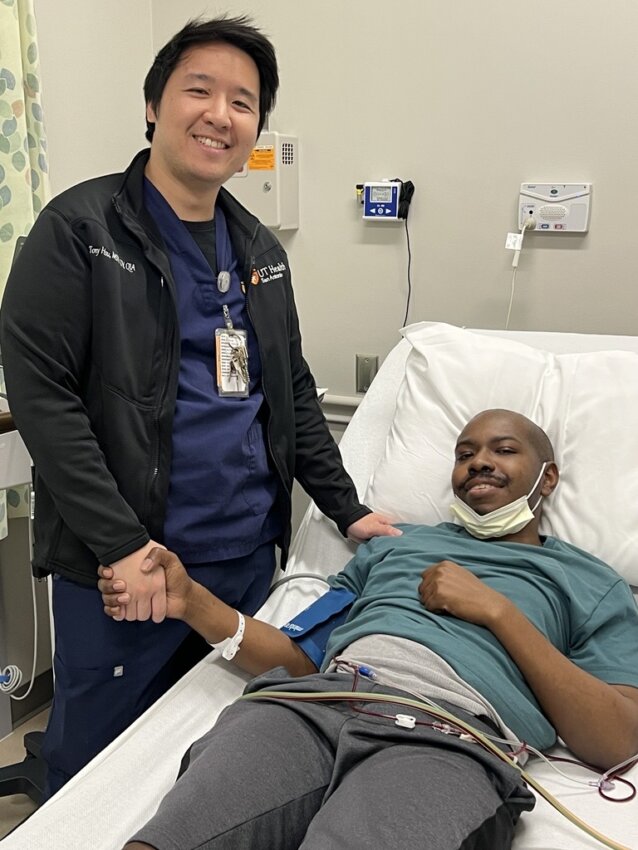
As supervisor of apheresis and cellular therapy services at UT Health San Antonio’s Mays Cancer Center and UT Health San Antonio Multispecialty and Research Hospital, Hsu helps collect cancer patients’ own blood-forming cells so they can be returned to their body in the future through transplantation.
“Before collection, patients receive medications that help increase the number of blood-forming stem cells, so they can be collected through apheresis,” Hsu said.
During apheresis, blood passes through a machine that uses a centrifuge to separate its components. A portion containing the blood-forming stem cells — a thin layer Hsu refers to as “liquid gold”— is collected, while the remaining blood is returned to the patient.
Throughout the several-hour collection, Hsu monitors the patient and the apheresis process. Some patients need additional collection sessions to reach their collection goal, making trust and communication important throughout the experience.
After collection, the cells are transferred to the hospital cellular therapy laboratory for processing and cryopreservation, or freezing, for later use.
Later, when the patient completes their planned high-dose chemotherapy, the stored cells are thawed and infused back into the bloodstream at UT Health San Antonio Multispecialty and Research Hospital. The cells travel to the bone marrow and begin producing new blood cells, helping blood counts recover over time.
Little did Hsu know that his commitment to excellence in patient care would extend beyond the hospital walls.
Care that goes the distance
About an hour after takeoff on a flight from Chicago to Bogotá, Colombia over the summer, a woman beckoned a flight attendant to help her mother, who seemed to be slipping in and out of consciousness.
The flight attendant quickly asked if there was a medical professional aboard.
Hsu, sitting immediately behind the lady in distress, raised his hand.
A day earlier, he had attended a close friend’s wedding and was looking forward to spending the rest of the week taking in the delicious foods and vibrant culture of Colombia’s capital city.
Now, he was jumping into action — again. This would be his third time rendering emergency medical aid during a flight.
“We were able to get the [passenger] up … and then kind of lead her back towards the [galley],” Hsu said. There, a soft covering was sprawled onto the floor, creating a comfortable space to gently lay the woman down.
Hsu measured the passenger’s blood pressure and oxygen saturation using equipment available on board. He provided supplemental oxygen and continued monitoring her condition. Over time, her blood pressure improved and she became more responsive.
Hsu learned that the passenger’s blood-pressure medication had recently been adjusted. That, along with her travel activities, may have led to her becoming unwell.
When the flight crew asked about returning to Chicago, Hsu explained that the passenger had become more responsive and that her blood pressure was improving. He advised that continuing appeared reasonable based on her condition at the time, and the flight continued to Bogotá.
Hsu monitored the patient as she drank some orange juice and rested in the galley. Once she was able to answer questions and her blood pressure continued to climb, she returned to her seat and the diligent RN sat beside her, monitoring her for the remainder of the flight.
Hsu drew on years of nursing experience, including the sustained observation and patient communication central to his work in apheresis, a process that may sometimes take six-to-seven hours.
After the plane landed, paramedics promptly took the patient to the hospital.
A history of heroism in the sky
As an avid backpacker who has visited 72 countries, Hsu had rendered medical aid on two other flights.
During a flight to Chicago about two years earlier, Hsu assisted a young man who was unresponsive.
Thirty minutes before landing, a flight attendant asked via intercom if there was a medical professional on board. Hsu raised his hand.
“I walked up and he was sort of sitting in the middle section of the plane and he just passed out,” Hsu said.
The crew members promptly provided Hsu medical equipment.
“I did what I could, monitored [the patient] and gave oxygen. [I was] ready to do CPR if needed,” Hsu said, adding that he asked for an automated external defibrillator — a medical device that delivers electric shocks during sudden cardiac arrest — in case the patient needed it. “I had the patches on just in case and the machine was on.”
The man’s blood oxygen level was hovering between 89% and 90%. Normal blood oxygen levels range from 95% to 100%.
“You [could] tell he was having trouble breathing a bit … even when we were giving him supplemental oxygen,” Hsu said, adding that he was glad that the plane was close to landing at that point.
Once the plane touched down, the crew promptly got him off the plane and were met by paramedics waiting at the gate.
Although the emergency ended safely at the gate, it was not Hsu’s first experience providing medical aid in the air.
During another flight from Colombia to Chicago, a flight attendant asked for medical help when she couldn’t wake a woman slumped over in her window seat.
“One of the flight attendants was a part-time paramedic [I believe], so we were able to get her up to the front of the galley, lay her down and then we put blankets on her,” Hsu said. “Then we did the sternum rub, which is like rubbing in the center of the chest. That’s usually a more effective way to wake someone.”
When the woman in her mid 20s woke up, Hsu and the flight attendant with the medical background gave her three containers of orange juice to drink and she felt much better. Upon returning to her seat, Hsu sat next to her, monitoring her for the next two hours, until the plane landed at O’Hare International Airport.
Hsu had learned the woman had a grueling day, rushing between airports to transfer planes without eating anything.
During each of the three flights, Hsu exhibited the traits he relies on daily in his role at UT Health San Antonio: composure, precision and compassion.
A lifeline collected with care
For Hsu, providing medical aid with a calm, reassuring presence is more than a responsibility. It’s a calling.
Today, Hsu’s own condition is in remission.
“I’m still able to work and I count myself lucky for that,” Hsu said.
Drawing on his own experiences with medical providers, he understands that building trust with patients is essential, particularly in a profession defined by such intricate work. That commitment extends beyond the hospital’s walls, where he believes he has a moral obligation to help others.
“Even when you’re off duty, you’re always on,” Hsu said. “I feel like you have to do what you can to help [people in medical need].”